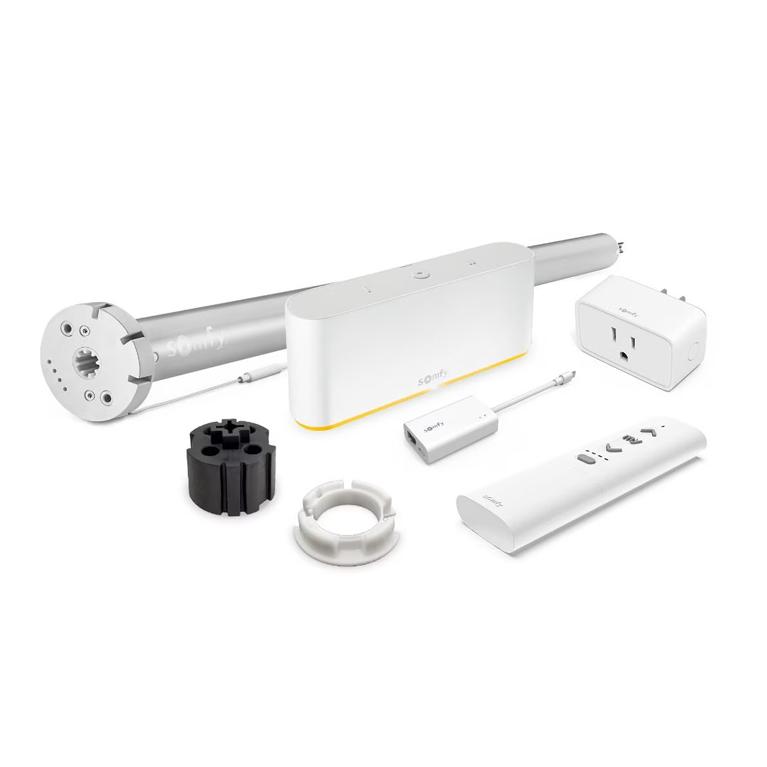
Short answer: Specify the Maestria 50 RTS on any exterior vertical screen and lean on it hardest for zip screens. Pick 10, 25, 35 or 50 Nm from the screen maker's chart. All four run on 120V AC with IP 44 and a built-in RTS receiver. Obstacle detection works on zip screens only: a heavy load bar plus a physical stop at the top.
A zip screen that chews its fabric at the bottom of a guide costs a truck roll, a fabric order and a client who stops trusting the system. The motor line on your spec decides most of that before the screen ships. Write the Maestria spec so the installer knows the torque, the limit mode and the obstacle setting for every opening.
Free spec package
Maestria 50 RTS exterior screen spec package

- SMD-01 system limits schedule with a source for every number
- SMD-02 motor elevation, head end view, length schedule, headbox detail
- SMD-03 RTS control riser and wiring schedule
- SMD-04 3-part guide spec, BOM and submittal checklist
Pick Maestria torque from the screen maker's chart
Somfy builds the Maestria 50 RTS in four torques. The Maestria 50 RTS 535A2 (1134084) turns 35 Nm at 20 rpm and draws 2.1 A. The 510A2 (1134082) gives 10 Nm at 20 rpm and 1.3 A. The 525A2 (1134083) gives 25 Nm at 20 rpm and 1.6 A. The 550R2 (1134095) gives 50 Nm at 14 rpm and 2.1 A.
Every model shares the same platform: 120V AC at 60 Hz, IP 44, electronic RTS limits with 250 turns of capacity, 5-minute thermal protection and a 14 to 104 F working range. Fabric weight, drop and load bar set the torque. The screen manufacturer owns that chart.
Our rule: copy the torque from the screen maker's sizing chart onto your opening schedule. Never round down to save a few dollars on a 25 Nm motor that has to fight a heavy zip bar.
Obstacle detection only works on a true zip screen
Somfy states it plainly: obstacle detection is available for zip screens only. Somfy also defines the term. Any screen with a heavy load bar and a physical stop at the upper end limit counts as a zip screen.
On a qualifying screen the Maestria detects an obstacle traveling up or down and stops. A back-release function then releases the motor brake so the fabric does not bunch or slip out of the guides. Somfy says the detection tells a real obstacle apart from wind gusts, so the screen does not stop for nothing.
Installers can raise the sensitivity above the default or turn detection off for the downward move. Write the setting into the spec. Leave it at default unless the owner or the screen maker directs a change.
Maestria 50 RTS hard numbers
- 10 / 25 / 35 / 50 Nm at 20 / 20 / 20 / 14 rpm
- Rated current 1.3 / 1.6 / 2.1 / 2.1 A at 120V AC, 60 Hz
- IP 44, working range 14 to 104 F (-10 to 40 C)
- 250-turn electronic limits, 5-minute thermal protection
- Antenna in the power cord: keep 12 in free of metal contact
- Programming: 2 s max between presses, 2 min idle ends the mode
Choose the limit setting mode by the top stop
Maestria offers three limit setting modes: automatic, semi-automatic and manual. The top of the screen picks the mode for you. Somfy limits automatic setting at the up end to screens with a hard stop.
Automatic mode finishes in two steps. The installer sends the screen down from halfway, the motor finds the lower limit, makes a short upward move and returns. Somfy says this mode adjusts fabric tension and keeps it constant over years of use. Semi-automatic mode has the installer set the lower limit by hand while the motor finds the upper limit. Manual mode sets both limits by hand for screens with no hard stop.
Two timing rules catch new installers. Each programming press has to land within 2 seconds of the last one. Leave the motor idle for 2 minutes and it exits programming mode, so the sequence starts over.
Our rule: add a "hard stop at top: yes or no" column to the screen schedule. That one cell tells the installer which mode to run before anyone climbs a ladder.
Plan power and the antenna before the headbox closes
Each Maestria ships with a 3-conductor SJTW power cable, 9.8 ft (3 m) per Somfy's 500 Series Databook: black is hot, white is neutral, green is ground. Somfy offers optional 3-conductor cables with a NEMA plug, a Fast Connector or open leads, so you can specify a receptacle or a hard-wired J-box at each headbox.
The RTS antenna lives inside the power cord. Somfy requires at least 12 inches of cord that never touches metal. Zip cassettes and side guides are usually aluminum, so call out the cord route on the drawings. A cord coiled against the cassette wall is a range complaint waiting to happen.
Mount the star head in an LT50 bracket. Somfy lists the LT50 universal motor bracket (9410651), rated to 50 Nm, as a Maestria accessory, along with the drive stop and screw (9910004) that keeps the drive wheel on the motor shaft.
Add RTS controls, sensors and TaHoma to the schedule
Each Maestria stores up to 12 RTS channels. For a patio with a few screens, a Situo 5 RTS remote (1870575) covers five channels. For a whole outdoor room, the Telis 16 RTS remote (1811081) covers sixteen. Somfy lists TaHoma Switch (1871037) as compatible with the Maestria RTS for app, voice and schedule control. TaHoma Switch holds up to 40 RTS channels.
Weather sensors protect the screen when nobody is home. Somfy pairs Maestria with the Eolis RTS wind sensor 24V kit (9012499), the Ondeis WireFree RTS rain and sun sensor (9019617) and the Sunis WireFree RTS sun sensor (9020412). Sunis sun commands need a Situo 5 Soliris RTS remote (1870579) to switch sun automation on and off.
Order matters here. Somfy warns that if the hand-held transmitter direction is programmed wrong, an Eolis or Soliris sensor will not work as intended and screen damage or injury can follow. Set and test direction first. Pair sensors second.
Write the Maestria spec section
Somfy's specification support covers exterior sun control under Section 10 71 13. Our package gives you a 3-part guide spec with bracketed items for torque, controls and sensors. Edit the brackets, then attach these items to the submittal:
- Somfy Maestria 50 RTS spec sheet D-0093
- Opening schedule with screen type, torque, hard stop yes or no, and limit mode
- Channel map: opening, remote, channel
- Sensor list with mounting points, plus the obstacle setting for each zip screen
Somfy backs its motors and controls with a 5-year warranty. A clean schedule keeps your crew from spending any of it on avoidable callbacks.
Take the spec package to your submittal
Get the Maestria 50 RTS drawing set
- System limits schedule with sources
- Motor elevation and headbox detail
- RTS riser and wiring schedule
- Editable 3-part guide spec and checklist
FAQ
Can the Maestria 50 RTS run a standard cable-guided screen?
Yes. Somfy lists three screen types for Maestria 50 RTS: standard screens on rail or cable guides, screens with locks, and zip screens. Obstacle detection stays reserved for zip screens.
Does Maestria obstacle detection work going up and going down?
Yes. Somfy says the Maestria detects obstacles traveling up or down on zip screens, then releases the motor brake to prevent fabric damage. Installers can raise sensitivity or switch detection off for the downward move.
Which Maestria limit mode needs a hard stop?
Automatic and semi-automatic setting find the upper limit on their own, and Somfy limits that to screens with a hard stop at the top. Screens without a hard stop use manual limit setting.
What temperature range does the Maestria 50 RTS handle?
Somfy's spec sheet D-0093 lists a working range of 14 to 104 F (-10 to 40 C), with IP 44 protection and 5-minute thermal protection.
Sources: Somfy Maestria 50 RTS spec sheet D-0093 (3/2018); Somfy 500 Series Databook (12/2021, p.20 and p.39); Somfy Maestria 50 RTS brochure L-0280 (1/2018); Somfy Maestria Quick Programming Guide P-0030 (10/2018); somfysystems.com product page 1134084 and Maestria obstacle detection support article; Somfy TaHoma Switch spec sheet D-0150 and integration guide; Somfy Sunis WireFree RTS product page; Somfy specification support page.
Ryan Towns writes the Somfy Integrator Guides for ShadeMotorsDirect, an authorized Somfy distributor. Questions on a spec or a retrofit: 859-414-6872 or colin@shademotorsdirect.com, 8:00 AM - 7:30 PM ET.