Collection:
Somfy Smart Hubs
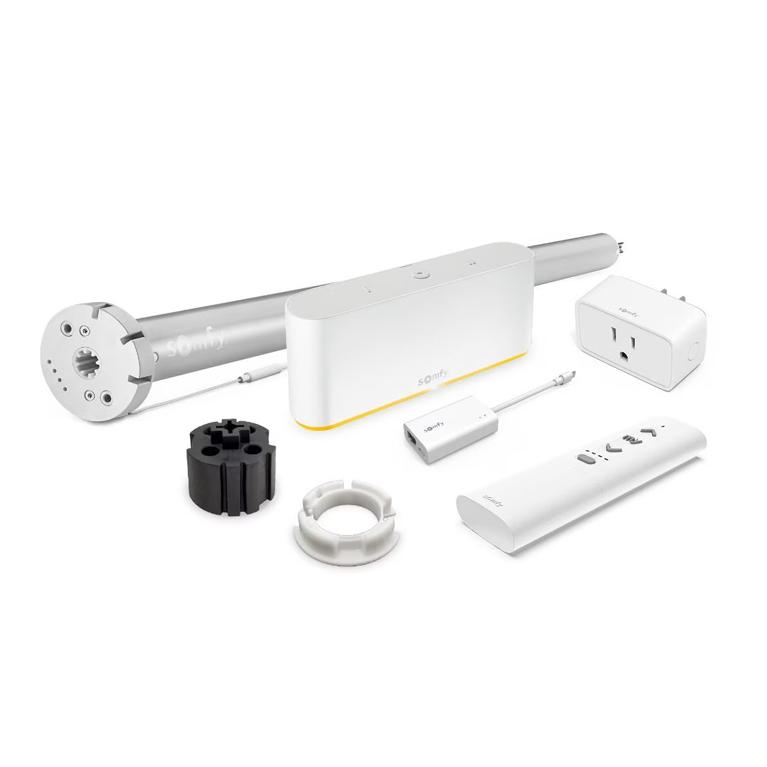
The Somfy TaHoma switch is the hub that turns individually-controlled shades into a system you can schedule, automate and speak to.
It runs the Zigbee 3.0 mesh, speaks RTS to older motors, and bridges to Amazon Alexa and Google Home — so a house with a decade of RTS shades and a new run of Zigbee ones runs from one app. Ethernet adaptor and mesh extenders stocked alongside.


Which Somfy hub do you actually need?
TaHoma Switch: the default
The TaHoma Switch (1871037) is the hub most homes want. It runs a Zigbee 3.0 mesh at 2.450 GHz, transmits RTS at 433.420 MHz for older motors, and bridges to Amazon Alexa and Google Home. One app then schedules every shade in the house, whether it was installed last month or ten years ago.
One limit is worth knowing before you quote it. The Switch can drive RTS motors, and it cannot receive from them, because RTS is a one-way radio. Zigbee motors report their real position back; RTS motors will show whatever the app last commanded.
TaHoma Beecon: RTS only, at a lower price
The TaHoma Beecon RTS Interface (1811731) covers RTS motors alone. On a house with no Zigbee hardware and no plan to add any, it does the same scheduling and app control for less. If there is any chance of Zigbee motors later, buy the Switch instead and skip the second purchase.
Wired networks: Ethernet and the Data Hub
Wi-Fi in a mechanical room or a steel-framed building is where hubs fail. The TaHoma Switch Ethernet Adaptor (9028054) puts the hub on a wired drop, and the bundle (1871038) ships the two together. The Somfy Data Hub V2 (1870951) serves SDN and commercial installations, where motors sit on an addressable RS485 bus rather than a radio.
Placement decides whether the mesh works
Zigbee open-field range is 262.5 ft, well short of the 656.2 ft Somfy publishes for RTS, and it drops fast through masonry and foil-backed insulation. Zigbee makes that back by meshing: every mains-powered Zigbee device repeats for its neighbors, so battery motors at the far end of a house reach the hub through the wired ones. Mount the hub centrally, and add mains-powered devices along the path rather than moving the hub.
Related guides:TaHoma Switch setup and capacitySomfy RTS vs Zigbee compared
Common questions
What does a TaHoma hub actually add?
App control from a phone, scheduling by time or sunrise and sunset, scenes that move several shades at once, and voice control through Alexa and Google Home. Motors still work with their remotes if the hub is offline, because the remote talks to the motor directly.
Does the TaHoma Switch control both RTS and Zigbee?
Yes, which is what makes it the practical bridge for a property with older RTS shades adding new Zigbee ones. Both appear in one app with shared scenes and schedules. RTS shades still cannot report their position, because RTS is one-way.
How many motors can one hub handle?
Enough for most homes, though the practical ceiling depends on protocol mix and radio conditions rather than a single published number. For large properties or commercial work above roughly thirty motors, SDN over an RS485 bus is the better architecture.
Do I need the Ethernet adaptor?
Only if Wi-Fi at the hub's location is unreliable. The adaptor gives the TaHoma Switch a wired network connection, which is worth it in a utility room or basement where the hub sits far from the router and shade commands would otherwise drop.
What is the TaHoma Beecon?
An RTS interface rather than a full hub. It brings RTS motors into the TaHoma app without the Zigbee radio. If everything on the property is RTS and you only want app and voice control, it is the smaller and cheaper route.
Shade Direct. Install Faster.
At Shade Motors Direct, we understand what installers need because we are installers. As a trusted distributor of Somfy motors, remotes, and controls, we provide high-quality automation solutions with fast shipping and expert support. We keep products in stock, offer competitive pricing, and make ordering simple, so you can focus on getting the job done. Whether you're outfitting a single shade or automating an entire home, we’re here to ensure you get the right products, on time, every time.