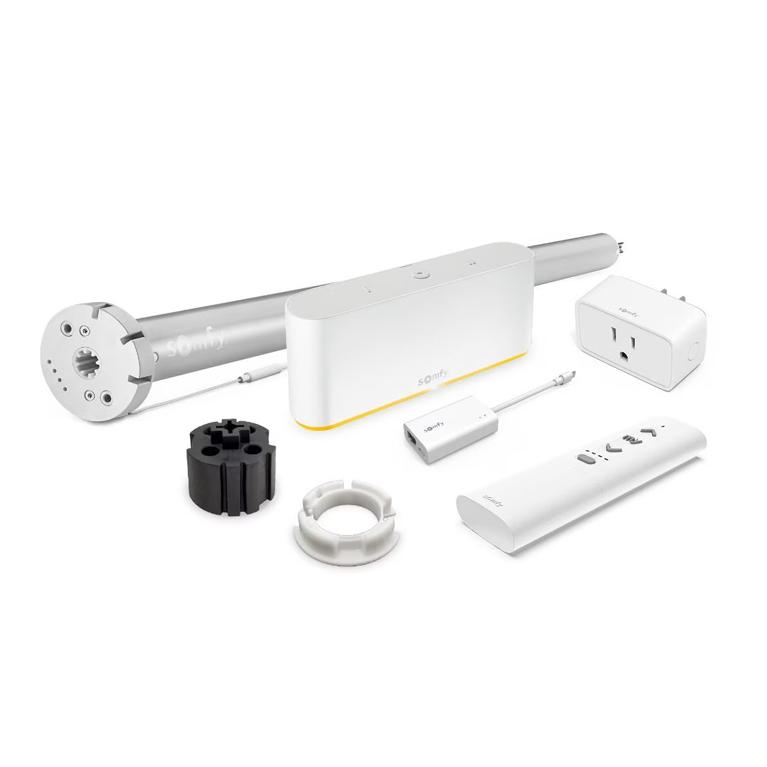
Short answer: This guide sets all four Somfy control systems side by side: RTS, Zigbee 3.0, SDN/RS485 and standard wired. Each one fits a different job, from hub-free RTS retrofits to addressable SDN on commercial facades, and the tables below compare range, feedback and wiring. For the two wireless options head to head, read Somfy RTS vs Zigbee compared.
Every Somfy motor speaks one control language, and it is set at the factory. It cannot be changed, upgraded or flashed later. That makes the protocol the first and least reversible decision in a motorization project, worth settling before you look at torque, tube or fabric.
The four protocols on Somfy's published figures
| RTS | Zigbee 3.0 | SDN / RS485 | Standard wired | |
|---|---|---|---|---|
| Carrier | 433.420 MHz radio | 2.450 GHz radio | RS485 bus cable | Switched line voltage |
| Range, open field | 65.62 to 656.2 ft, per motor | 262.48 to 656.2 ft per motor, extended by mesh | Cable length | Cable length |
| Direction | One-way | Two-way | Two-way | None |
| Reports position? | No | Yes | Yes, plus limits and faults | No |
| Addressable? | No | By hub | Yes, per motor on the bus | No |
| Hub required? | No | Yes, for app and scenes | Controller and power panels | No |
| Control wiring? | None | None | Bus cable to every motor | Switch legs to every motor |
| Security | Rolling code, 16 million combinations | Zigbee 3.0 encryption | Physical bus | Physical wiring |
| Typical scale | 1 to 30 motors | 1 to 30 motors | 30 to hundreds | Any, if wire is going in |
Sources: Somfy's product records for 1001809 (RTS), 1241755 (Zigbee 3.0) and 1002286 (RS485 / SDN).
The protocol does not change the motor
This is the point most buyers miss, and it makes the decision easier. Somfy builds the same mechanical motor and then fits different control electronics to it. The Sonesse 506S2 chassis is sold in at least three control flavors, and the mechanics are identical across all of them.
| Part | Control | Torque | Speed | Noise |
|---|---|---|---|---|
| 1001809 | RTS, built-in receiver | 6 Nm | 32 rpm | 45.1 dB |
| 1002286 | RS485 / SDN | 6 Nm | 32 rpm | 45 dB |
| 1001814 | Wired, 4-wire, no receiver | 6 Nm | 32 rpm | 45 dB |
So the protocol decision costs you nothing in performance. Size the motor for the shade, then pick the control layer for the building.
RTS, the wireless default
RTS (Radio Technology Somfy) is a one-way 433.420 MHz radio protocol, and it is what most Somfy motorized shades, blinds and awnings in North America use. The motor needs power, but no control wiring at all. You put the motor into programming mode and pair a remote or wall switch directly to it.
Somfy publishes open-field range per motor, from 65.62 ft on the Cord Lift CL32 to 656.2 ft across much of the range, and most RTS motors hold 12 transmitters in memory. Real range inside a building is far less, because 433 MHz has to cross plaster, brick, foil-backed insulation and metal studs on a single hop, with nothing in the system to relay for it. A shade at the far end of a large house may need a repeater or a relocated transmitter.
Because RTS is one-way, the motor never reports back. A remote tells it to go up and it goes up, but nothing confirms it arrived, and an app driven through an RTS bridge shows the last command rather than the actual position.
RTS has the widest accessory range by a long way: Telis and Situo remotes, DecoFlex and Smoove wall switches, Chronis timers, and Eolis and Soliris weather sensors. See the full RTS range.
Zigbee 3.0, two-way and app-native
Zigbee 3.0 is a two-way mesh protocol at 2.450 GHz. The motor reports its actual position, so an app showing a shade at 40 percent is showing where it is rather than what it was last told. Each mains-powered Zigbee device also relays for its neighbours, so coverage grows as you add motors instead of shrinking.
Somfy publishes Zigbee range per motor, from 262.48 ft on the Sonesse WireFree Zigbee motors to 656.2 ft on the wired Sonesse 40 Zigbee 406A2. The mesh extends that reach, which means the advantage is real in a house full of mains-powered Zigbee shades and much weaker in a house of battery ones, since battery motors sleep and generally do not relay.
Zigbee motors pair directly to Ysia remotes with no hub, or join a TaHoma switch for scheduling, scenes, Alexa and Google Home. The TaHoma switch also speaks RTS, which makes it the practical bridge for a property with a decade of RTS shades adding a new run. Browse the full Zigbee range, or read the deeper RTS vs Zigbee comparison.
SDN / RS485, wired and addressable
Somfy Digital Network is the hardwired, addressable system for commercial glazing and large residential facades. Every motor gets an address on an RS485 bus and reports its position, its limits and its faults back to the controller. Nothing depends on radio, which is the whole point in a building where hundreds of motors have to be commissioned, documented and serviced years later.
The tradeoff is infrastructure. SDN needs 24V power panels, distribution enclosures, plenum or non-plenum bus cable, DecoFlex digital keypads, and the RS485 commissioning tool to set limits and read addresses. That cost only makes sense at scale, and at scale nothing else compares. Somfy rates the SDN Sonesse 506S2 for 250 limit turns and 0.5 W standby.
Standard wired, 3-wire and 4-wire
Standard wired motors have no radio receiver at all. A 4-wire motor takes line, neutral, up and down from a dry-contact switch or a relay module. A 3-wire RTS motor has the receiver built in but still runs on line voltage, so the wire count alone does not tell you whether a motor has radio. Check the listing.
Wired motors are the least expensive per unit and the most dependent on the electrician. They suit new construction where control wiring is going in anyway, and jobs where a third-party automation system drives the shades through relays. A plug-in RTS receiver can add radio later, and the URTSI II bridges third-party automation into RTS.
Choosing between them
Retrofitting one room or one elevation. RTS. No wiring, widest control range, and nothing to maintain.
App control, voice control or automation that reads position. Zigbee, and specify mains-powered motors so the mesh is worth having.
Commercial facade, or more than roughly thirty motors. SDN. Addressability and fault reporting stop being a luxury at that count.
New construction with a contractor already pulling wire. Price standard wired against RTS. The motor is cheaper; the labour may not be.
One rule outranks all of this: controls only drive motors that speak the same protocol. A Ysia Zigbee remote will not operate an RTS motor, and an RTS remote will not operate a Zigbee motor, however many times you try to pair them. Every product listing states its protocol. Check it before ordering the control layer.
Common questions
Can I change a motor from RTS to Zigbee later?
No. The receiver is built into the motor at manufacture. Changing protocol means changing the motor.
Which protocol has the longest range?
It depends on the motor. Somfy publishes open-field range per motor, from 65.62 to 656.2 ft across RTS and from 262.48 to 656.2 ft across Zigbee. Across a whole property, Zigbee often delivers better coverage because mains-powered devices relay for each other.
Does choosing a protocol cost me torque or speed?
No. The Sonesse 506S2 delivers 6 Nm at 32 rpm in its RTS, RS485 and 4-wire versions alike.
Do I need a hub?
Not for RTS, and not for Zigbee if you only use Ysia remotes. You need one for app control, schedules, scenes or voice on either protocol, and SDN needs a controller by design.
Can RTS and Zigbee shades coexist?
Yes. The TaHoma Switch controls both from one app. The RTS shades still will not report their position.
Once the protocol is settled, the next question is torque. See How to Size a Somfy Shade Motor, or the guide to Somfy model codes.