80%
Five per foot. Shallowest wave, tightest stack. For when the drapery has to clear a door.

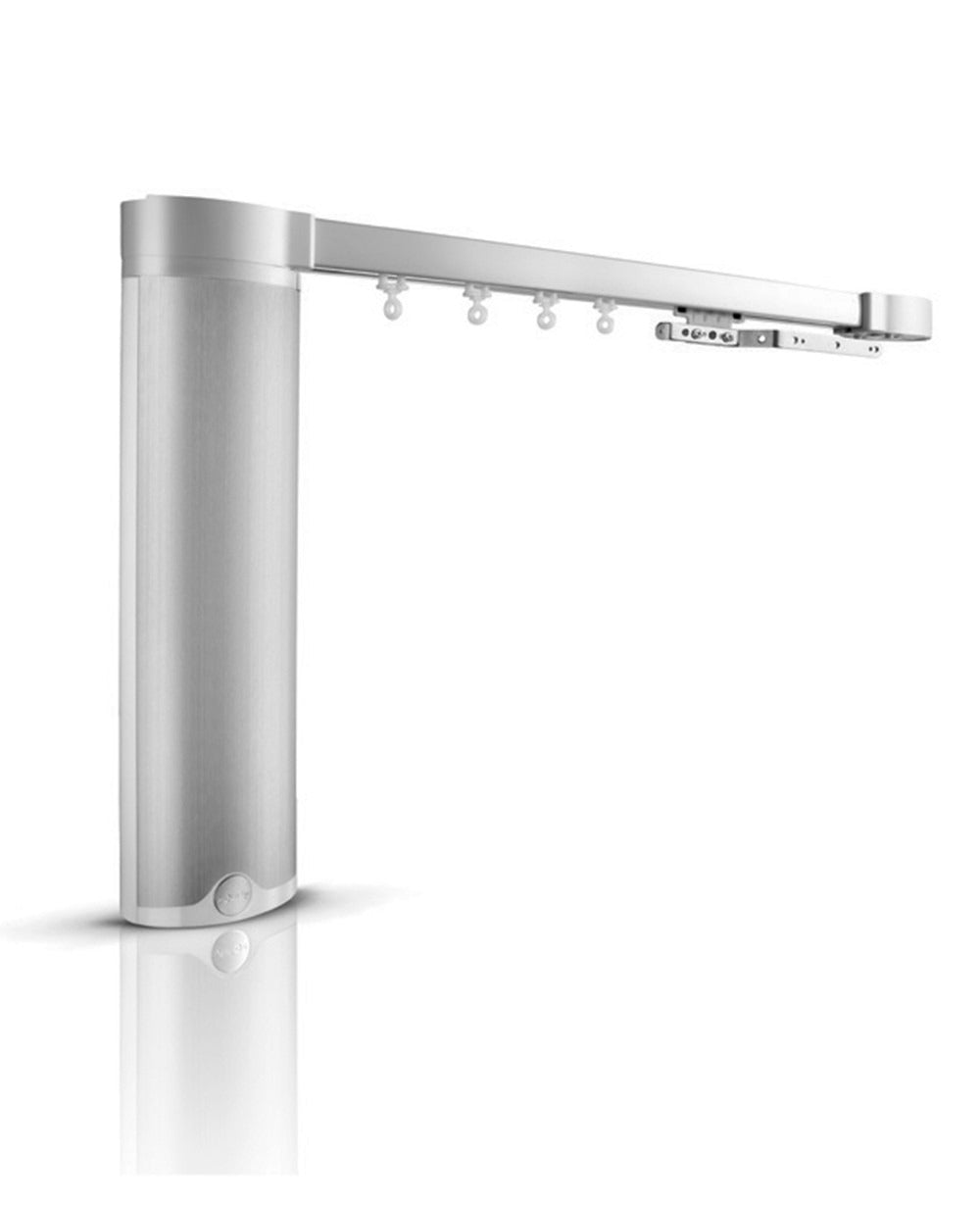
We work directly with Somfy to build these tracks to your project's needs. Set the width and the fabric, and the drawing updates as you go, with every part listed by its Somfy number.
| System total | — | ||
Somfy builds a drapery motor for each power situation. Your choice here narrows the later steps to the motors made for that range.
Somfy builds a separate motor for each technology, so this sets the motor rather than adding a part to it. Pick whatever your home already runs on. If you are starting fresh, RTS is Somfy's own radio and needs nothing wired between the switch and the track.
Measure wall to wall, or the full span the drapery should cover. The track is cut to that measurement. The 10 ft shown is a starting point, so change it to yours.
Both are Somfy powder-coated finishes on the same extrusion. Pick the one that disappears against your ceiling.
Pick the closest match and we specify the motor for it. The ranges are the total drapery the track carries, and each one sits inside the rating of the motor it selects.
The bracket count follows the track length, so it is worked out for you and priced in the list on the left.
Which way the panels travel. One-way suits sliders, corners and anywhere the stack needs to land on one side.
Where the two panels meet in the middle.
Ripplefold carriers ride inside the track and hold an even wave across the whole run. Pinch pleat hangs from runners rather than carriers.
The housing sits at one end of the track. Put it on the end nearest the power, or the end least in view.
At this width you can have it either way. Up to 16 ft a track can travel in one piece, so the choice is yours. Past 16 ft it cannot, and we splice it automatically.
Every track is built to order and takes 10 to 23 days.
Somfy backs the motor with a 5-year warranty.
Drapery fabric, panel fabrication and installation are not included. The track arrives ready to mount, with the carriers and hardware listed on the left.
Showing 120V AC, Somfy RTS, ceiling mount, centre draw, Ripplefold 100%.
Hover any numbered part for what it does and its Somfy part number.
Sits in line with the track at the end you choose.
Cut to your finished width. Belt and carriers run inside it.
Three on a 4 ft track, up to eleven on a 30 ft track.
Evenly spaced so the wave stays regular end to end.
What the leading edge of the panel attaches to.
Rechargeable 25.9V pack. No cable, no outlet.
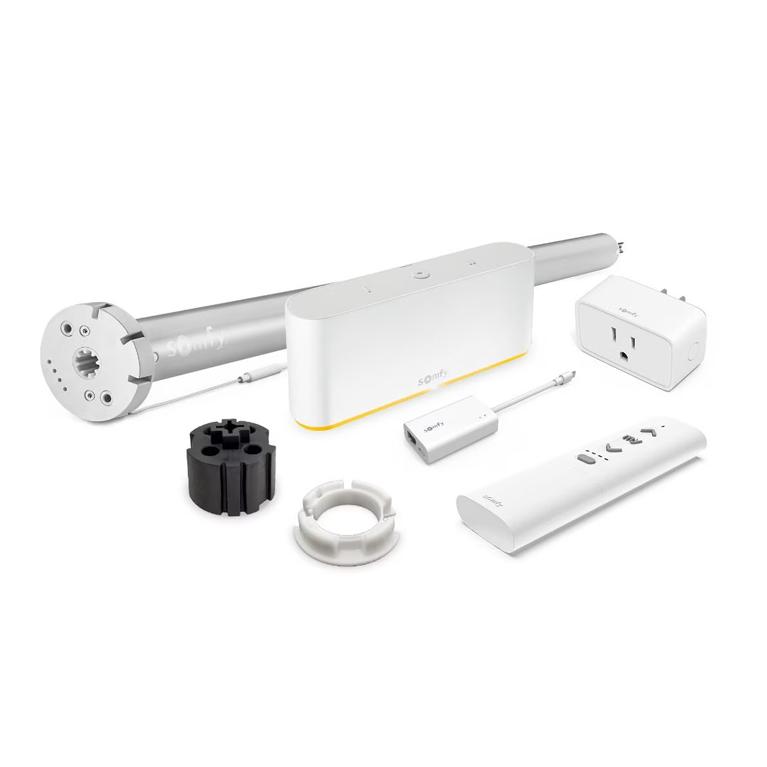
Pairs to the motor you picked. Skip it if you already own one.
Added to the motor when your control choice needs it.
Scheduling, scenes and voice. Handles RTS and Zigbee together.
Tops the WireFree pack back up. One covers any number of motors.
Dry contact and wired motors take their commands from your own system or a line-voltage switch, so no Somfy control is needed.
The receiver is inside the motor, so there is no separate box. Power the track from an outlet and pair a remote or a wall switch to it by radio. Nothing runs between the switch and the track.
Add a TaHoma hub later for app control, schedules and voice. One hub handles up to 40 RTS channels.
Two-way, so the hub knows where the panels actually are rather than where it last told them to go. That is what gives you real position feedback in an app or a control system.
A TaHoma Switch handles up to 60 Zigbee products and doubles as the RTS hub, so a mixed install needs one box, not two.
No radio. The motor takes open, close and stop from your control system over an RJ12 run, which is how it lands in Control4, Crestron, Savant or a plain relay. Your integrator supplies the interface.
Somfy's published run limits: Cat5 or equal to 328 ft with up to 10 motors; 0.75 mm² to 656 ft with up to 20. Dry contact does not apply to the Irismo 45 WireFree.
An RS485 bus, addressed and wired rather than broadcast. Every motor sits on one run and answers to its own address, which is what makes it hold up on a large or commercial job where radio gets crowded.
The module is added to a dry contact motor, so the build above puts an RS485 module on your parts list automatically.
Line voltage, no radio at all. The motor ships with a cable and no plug, and an electrician terminates it to a switch. The simplest thing on this list, and the one that never needs pairing.
Somfy's wiring: brown is direction 1, black is direction 2, blue is neutral, green and yellow is ground. Group control needs a double pole double throw switch, up to 7 motors.
Carriers space the fabric evenly along the whole run. The percentage is how much extra fabric goes into each wave, which changes both the look and how much wall the panels need when open.
Five per foot. Shallowest wave, tightest stack. For when the drapery has to clear a door.
Six per foot. Where most projects land, and the safest default.
Seven per foot. Deepest wave. Budget more wall for the stack.
Measure the finished width you want the track to span, wall to wall or the full opening you want covered. We cut to that measurement. For an inside mount between two walls, deduct about half an inch so the track is not fighting the plaster.
Yes. Choose the end nearest your power, or the end least in view. On a centre draw it makes no difference to how the panels travel.
Butt close brings the two panels edge to edge. Overlap crosses them slightly at the centre so no light comes through the joint, which is what you want in a bedroom or a media room.
No. An RTS motor works with a remote or wall switch on its own. A TaHoma hub adds app control, scheduling and voice, and handles both RTS and Zigbee, so one hub covers a mixed install.
Every track is built to order, and that takes 10 to 23 days. Somfy backs the motor with a 5-year warranty.
Drapery fabric, panel fabrication and installation. The track arrives ready to mount with the carriers and hardware listed in your build.
Your cart is currently empty.
Not sure where to start? Try these collections: