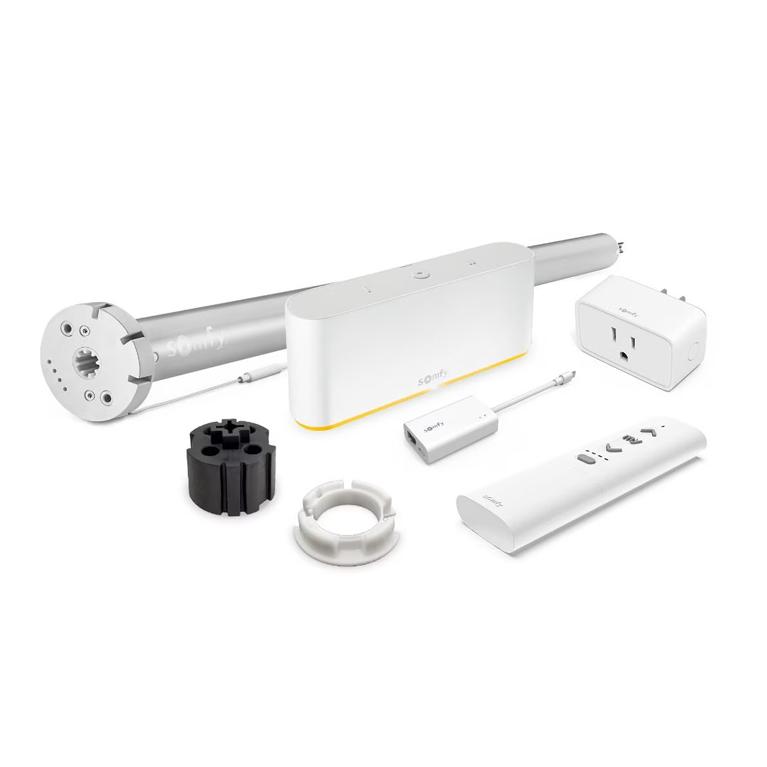
Short answer: Somfy replaced the Sonesse 30 RTS 1001524 with the Sonesse 30 RTS 24V DC 1241142. Torque stays at 2 Nm and the supply stays 24V DC. The motor grows to 17.72 in, the JST plug becomes a Weidmüller pigtail, default speed drops to 25 rpm, and every control gets paired again.
One failed motor turns into two truck rolls when the replacement meets the job unprepared. The motor binds in a narrow tube. The plug has nothing to mate with. The new shade trails the seven beside it. Each of those costs a return trip, and each one takes minutes to catch before the old motor comes out.
Free spec package
Sonesse 30 RTS 1001524 to 1241142 drawing set

- SMD-01: old vs new limits schedule with sources
- SMD-02: motor length elevation and tube hardware schedule
- SMD-03: power riser, connector change and re-commissioning sequence
- SMD-04: guide spec, bill of materials and closeout checklist
Confirm the motor before you order
Read the label on the failed motor. Ref 1001524 is the obsolete Sonesse 30 RTS, and Somfy names the 1241142 as its replacement. The 1241142 is a 24V DC radio motor. The DCT, RS485 and Zigbee versions of the 24V Sonesse 30 take different controls, so match the part number and ignore look-alikes.
Line up the ratings next. The table shows what carries over and what changes.
| Item | 1001524 (obsolete) | 1241142 (current) |
|---|---|---|
| Torque | 2 Nm | 2 Nm |
| Speed | 10-28 rpm, default 28 | 6-28 rpm, default 25 |
| Current | 0.8 A nominal | 0.625 A rated |
| Thermal limit | 2.5 min | 6 min |
| Limit capacity | 35 turns | 150 turns |
| Published length | 16 in (408 mm) | 17.72 in (450.2 mm) |
| Power connection | 2-pin JST, 2 mm pitch | 9.8 in pigtail, Weidmüller connector |
| Polarity | Stripe +, white - | Red +, black - |
Dry-fit the longer motor
The 2019 Low Voltage Databook lists the 1001524 at 16 in (408 mm). The June 2026 edition lists the 1241142 at 17.72 in (450.2 mm). Plan for 1.72 in more motor inside the tube.
Wide shades absorb that without notice. Narrow shades do not. Check any tube with a short clear length, an idler plug that reaches deep, or hardware fastened inside the tube. Tube ID must still exceed 31 mm, the same rule on both motors.
Our rule: slide the new motor, crown and drive into the tube on the bench before the shade goes back on its brackets. A two-minute dry fit beats a second lift rental.
Land the supply on the new connector
The 1001524 took a 2-pin JST plug, 2 mm pitch, with the 7.5 ft, 24 AWG power cable 9014794. The stripe was positive and the white wire negative. The 1241142 carries a non-removable 9.8 in pigtail, with red positive and black negative, and ships with a Weidmüller 2-position connector, part 9027985.
Retire the JST cable and bring the building run to the Weidmüller connector. Meter the run first. Mark positive, match it to the red lead, and confirm your conductor fits the connector before you close the headrail. Never cut the motor pigtail. Somfy treats that cable as part of the motor.
Voltage at the motor must sit between 21.6 and 26.4V DC. Rated current falls from 0.8 A nominal to 0.625 A, so a healthy supply that ran the old motor has the rating covered. Long runs still follow the same limits: 240 ft on 14 AWG, 150 ft on 16 AWG, 100 ft on 18 AWG. A single motor can run from the 1822209 24V DC plug-in supply. Banks belong on a 5-motor distribution kit 1870196 or a 10-motor kit 1870192. Those kits are not for SDN installations.
Hard numbers for this swap
- Supply at the motor: 21.6-26.4V DC
- Tube ID: greater than 31 mm
- Motor length: 17.72 in (450.2 mm)
- Head screw holes: 29 mm apart, 3 mm diameter, 7 mm deep
- Antenna: 7.5 in, exposed, never cut or lengthened
- Paired controls: 12 maximum
Keep the tube and renew the drive hardware
Both databooks call out 29 mm between the head mounting holes and both use an M3.5 x 9 mm screw, sold as 9014066. Existing plates and brackets can carry over. Check the plate against the bracket on site.
Match the crown and drive to the tube you have. RollEase 1.5 in tube takes 9020674. The RollEase and ZMC 2 in profiled tube takes 9021017. Louvolite 40 mm takes 9020675 and Hunter Douglas 37 mm takes 9020699.
Somfy 40 mm tubes need one more part. Round tube uses 9012224 or rubberized 9016654, and octagonal tube can use rubberized 9016655. Each pairs with the 9020676 adaptor kit.
Bracket plates cover the common systems: 9012258 for RollEase R8, 9025996 or 9026001 for RollEase 360, 9026003 or 9016378 for Skyline, and 9013789 for Acmeda.
Our rule: order a new crown and drive set with every motor. The set includes the Sonesse 30 drive stop and screw, which Somfy recommends to prevent noise and drive wheel separation. The motor ships with a white head cover. Grey 9027133 and black 9027134 covers exist for exposed heads.
Rebuild limits and pairing in order
The new motor knows nothing about the job. Before removal, list every control that ran the old motor: wall switches, a Situo 1, channels on a Situo 5 or Telis 16, a URTSI II channel and any TaHoma Switch scene. A missed group channel surfaces as a callback.
- Power the motor. A steady orange LED means it is neither set nor paired.
- Press Up and Down together on the first control. The shade jogs and the green LED blinks 5 times.
- Press Up. If the shade lowers, hold My until it jogs, then press Up to confirm.
- Hold Up to the top position, then press My and Down together.
- Stop at the bottom position with My, then press My and Up together.
- Hold My until the shade jogs to save the limits.
- Briefly press Prog on the control to pair it.
- For each added control, hold Prog on a paired control until the shade jogs, then briefly press Prog on the new one.
Route the 7.5 in antenna where it stays exposed. Somfy says not to cut or lengthen it. If a headrail change hurts reception, an RTS Repeater 1810791 extends coverage.
Match speed to the row
The 1001524 defaulted to 28 rpm. The 1241142 defaults to 25 rpm and adjusts from 6 to 28 rpm. Drop one new motor into a bank of older shades and the difference shows on the first group command. It reads as a defect, even though every shade works.
Our rule: time an adjacent shade over a fixed drop before you start. Then move the new shade off its limits and hold Up, My and Down until it jogs. Hold Up to raise speed or Down to lower it, one jog per step. Three jogs mark the top or bottom of the range. Hold My to save, then time the shade again.
Take the spec package to your submittal
Take the 1001524 replacement set to the job
- SMD-01: old vs new limits schedule with sources
- SMD-02: motor length elevation and tube hardware schedule
- SMD-03: power riser, connector change and re-commissioning sequence
- SMD-04: guide spec, bill of materials and closeout checklist
FAQ
Is the 1241142 the replacement for the Somfy 1001524?
Yes. Somfy lists the Sonesse 30 RTS 24V DC, ref 1241142, as the replacement for the obsolete Sonesse 30 RTS, ref 1001524. Torque stays at 2 Nm. Length, power connection and default speed change.
Can the 9014794 cable plug into the 1241142?
No. The 9014794 cable ends in the JST connection used by the 1001524. The 1241142 has a non-removable 9.8 in pigtail and a Weidmüller 2-position connector, so the supply run lands on that connector.
Do existing RTS remotes work with the new motor?
Yes, after pairing. The new motor ships with no paired controls. Pair the first control after setting limits, then add the others. The motor stores up to 12 controls.
Does the Sonesse 30 RTS need a limit setting tool?
No. Somfy's databook states that RTS limits are set through the radio transmitter. Use the Up, My and Down buttons on the first control.
Sources: Somfy Low Voltage Databook L-0290, June 2026 and 2/2019 editions; Somfy Sonesse 30 RTS specification sheet, 5/2021; Somfy Sonesse 30 RTS instructions 5155873A, 12/2020; somfysystems.com product pages 1001524, 1241142 and 1870196.
Ryan Towns writes the Somfy Integrator Guides for ShadeMotorsDirect, an authorized Somfy distributor. Questions on a spec or a retrofit: 859-414-6872 or colin@shademotorsdirect.com, 8:00 AM - 7:30 PM ET.