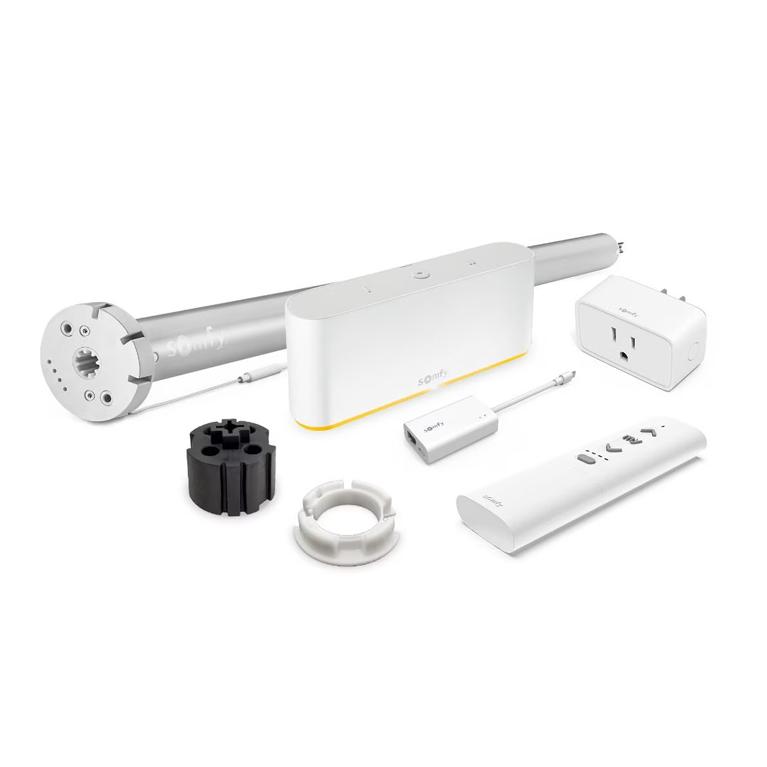
Short answer: Start from Somfy's CSI 3-part guide specification Section 12 25 09, Window Treatment Motors, Controls, and Automation Systems. Keep Part 1 submittals and the 5-year non-prorated warranty. In Part 2, delete the architectures you will not use and write a dBA ceiling. In Part 3, name who owns the low-voltage wiring and the commissioning.
A loose shade spec turns into a change order. The electrician prices line voltage at every window, the shade contractor assumes someone else pulls the data cable, and a substitute motor shows up at submittal. Somfy already wrote the fix. This guide walks the 12 25 09 guide spec article by article, with the edits an integrator makes before the project manual goes out.
Free spec package
Somfy 12 25 09 guide spec package

- Spec map and system-limits schedule with a source for every number
- Section coordination detail and a motor schedule with photos
- Riser for wired, RTS and SDN, plus a wiring scope matrix
- Editable 3-part guide spec outline, BOM and submittal checklist
Place 12 25 09 in the project manual
Somfy publishes three CSI 3-part specifications for specifiers: 12 25 09 for window treatment motors, controls and automation, 12 22 00 for curtains and drapes, and 10 71 13 for exterior sun control devices. You find them on ARCAT, Deltek Specpoint and SpecBuildr, and Somfy offers customized spec support for a building's design intent.
Section 12 25 09 covers the motor operators and controls. The shade itself lives in 12 24 13, Roller Window Shades. The guide spec ties the two together through its related sections: 06 10 00 for blocking, 09 22 00 for gypsum board support, 12 24 13 for the shades, 26 05 00 for low-voltage and line-voltage power by others, and 26 09 43 for 0-10 V lighting integration. Keep every one that applies. Each line tells another trade the work is theirs.
Part 1: the submittals and warranty that protect you
Part 1 is where the integrator gets paid for paperwork. Article 1.4 asks for shop drawings, a product schedule, an operations description, installation instructions, riser diagrams, sensor positioning, a wiring detail, floor plans, O&M manuals and a final as-built package. A reviewer can reject a submittal that skips the riser. Leave that list intact.
Article 1.3 sets an optional pre-installation conference. Turn it on for any job with a network. Somfy's agenda covers low-voltage wiring, power and data separation, wire labeling, control locations, installer responsibilities and pocket conditions. One meeting settles the questions that cause most callbacks.
Article 1.6 holds the quality bar. It calls for certification by a Nationally Recognized Testing Laboratory (UL listed and/or cURus), ISO 9001, a manufacturer that supplies both 24 V DC and 120 V AC products, installers trained by the manufacturer, available commissioning services and a single manufacturing source for each product type. Article 1.9 sets a non-prorated manufacturer warranty of five years from the date of manufacture. Somfy's product pages for the Sonesse ULTRA 50 RTS and the Sonesse 50 RS485 list the same 5-year warranty.
Part 2: choose the architecture before the motor
Part 2 opens with Somfy as basis of design. Article 2.1 states that substitutions are not permitted and routes requests through Section 01 60 00. Keep that sentence. It protects the controls design you already priced.
The next three articles split by architecture. Delete the ones the project will not use, and the spec reads clean.
- 2.2 Wired: hard-wired motors and switch or keypad controls. The 24 V DC option is the Sonesse 30 DCT 24V DC (1241146) with a 6 ft cable, fed from a Somfy power distribution kit such as the 24V power distribution enclosure for 5 motors (1870196). The 120 V options are the Sonesse 50 and Sonesse ULTRA 50. The IGC 4n1 controller runs up to four motors.
- 2.3 Wireless RTS: radio motors with remotes, wall switches and interfaces. Somfy lists the Sonesse ULTRA 506A2 RTS (1002562) at 38 dB on 433.420 MHz. For a 24 V DC opening, the Sonesse 30 RTS 24V DC (1241142) draws 0.8 A. The Universal RTS Interface II (1810872) gives a control system 16 channels per unit, cascades to 16 units for 256 channels, and accepts RS232, RS485 or IR.
- 2.4 Digital network (SDN): RS485 motors on a Category 5e bus with 24 V DC NEC Class 2 power. Options run from the Sonesse 30 RS485 24V DC (1241144) at 24 V DC to the Sonesse 506S2 RS485 (1002286) and the LT50 RS485 at 120 V AC. Low-voltage SDN motors land on the SDN PowerConnect panel (1871026).
The guide spec limits app-based TaHoma control to residential tower projects. On a commercial project, write the URTSI II or an SDN interface into the controls paragraph instead.
Write the noise number as a ceiling
Acoustic performance is where a value-engineering round strips quality. Somfy's guide spec prints a sound rating for every motor family. Copy the number into Part 2 as a maximum and the cheaper substitute has to prove it.
Somfy 12 25 09 numbers to carry into your spec
- Sonesse ULTRA 50 (120 V AC 0.95 A, or 24 V DC 1.5 A): 38 dBA.
- Sonesse 30 (24 V DC, 0.8 A): 42 dBA or less.
- Sonesse 50 (120 V AC, 1.2 to 1.67 A, 6 to 10 N·m): 47 dBA or less.
- LT50 RS485 (120 V AC, 1.8 to 2.1 A, 15 to 35 N·m): 55 dBA or less.
- Warranty: 5 years, non-prorated, from date of manufacture.
- URTSI II: 16 channels per unit, up to 16 units (256 channels).
- PowerConnect: 10 low-voltage motors, 2 A fused per motor, 120 V AC 7.2 A input.
Speed matters too. The guide spec notes that LT50 speed depends on torque and tells you to use the same torque for all shades. Our rule: carry that line into any room where shades sit side by side, so a bank of shades moves together.
Controls and integration paragraphs
The controls paragraphs carry the numbers a BMS engineer checks first. For SDN, the Data Panel offers four isolated bus segments with up to 255 devices and 4000 ft (1219 m) per segment. The BMS Interface V2 handles 4500 data points over Modbus, BACnet MS/TP, BACnet IP and Metasys N2. The Universal Automation Interface Plus takes RS232 or IP Ethernet in and runs up to 250 motors. An animeo IP Building Controller manages up to 200 motors and expands with Sub Controllers.
On the PowerConnect panel, the guide spec allows motor cable runs up to 240 ft (73 m). Put that limit on the riser so the electrician locates panels before rough-in. Keypads draw 24 V DC from the bus and are for indoor use, so call out exterior sensor locations separately.
Part 3: execution and who owns the wire
Part 3 decides who pays for mistakes. Article 3.3 calls for installation per reviewed shop drawings and Somfy guidelines, NFPA 70 Article 400 for flexible cords, NECA 1 and NECA 130, grounding per NFPA 70, and BMS connection where specified. Exterior sun sensors mount per Somfy's instructions.
The guide spec leaves the wiring responsibility for the specifier to select: the roller shade contractor or Division 26. Pick one and write it. A blank here is the most expensive edit you can skip. Our rule: give power to Division 26, give bus and data to the shade or controls contractor, and show the split on the riser.
Article 3.4 covers adjusting. Shades run through the full range without binding, limits get set per Somfy's instructions, and motors get programmed to Somfy standard settings or the owner's. Commissioning follows Division 01 and can sit with the shade supplier, the motor manufacturer, the network integrator or a named commissioning agency. Name one. Article 3.5 closes with a demonstration and owner training by a factory-authorized Somfy representative.
The edit checklist before the manual ships
- Delete the Part 2 articles for architectures the project does not use.
- Fill every bracket: mounting, voltage, control locations, fabric and pocket conditions.
- Write a dBA maximum for each shade type.
- Select the wiring responsibility in Part 3 and match it in Division 26.
- Name the commissioning party.
- Attach a riser that shows panels, bus segments and the BMS connection.
The spec package below carries an editable outline of all three parts, a scope matrix for Division 12 and Division 26, and a submittal checklist built from Article 1.4.
Take the spec package to your submittal
Somfy 12 25 09 guide spec package
- Editable 3-part outline with bracketed items
- BOM by architecture: wired, RTS and SDN
- Submittal checklist built from Article 1.4
FAQ
What is Somfy guide specification Section 12 25 09?
It is Somfy's CSI 3-part specification for window treatment motors, controls and automation systems. It covers wired, wireless RTS and SDN digital network motors and controls, and it pairs with Section 12 24 13 for roller shades.
What warranty does the Somfy guide spec require?
Article 1.9 calls for a non-prorated manufacturer warranty of five years from the date of manufacture.
Who installs the low-voltage wiring in a Somfy shade spec?
The guide spec leaves that choice to the specifier: the roller shade contractor or Division 26. Select one in Part 3 and match it in the electrical sections.
Which Somfy motor is the quietest in the guide spec?
The Sonesse ULTRA 50 family at 38 dBA, in 120 V AC and 24 V DC versions. Sonesse 30 rates 42 dBA or less and Sonesse 50 rates 47 dBA or less.
Sources: Somfy Systems guide specification Section 12 25 09, Window Treatment Motors, Controls, and Networked Automation Systems (ARCAT listing); Somfy Systems specification support page for specifiers; somfysystems.com product pages for 1002562 and 1002286.
Ryan Towns writes the Somfy Integrator Guides for ShadeMotorsDirect, an authorized Somfy distributor. Questions on a spec or a retrofit: 859-414-6872 or colin@shademotorsdirect.com, 8:00 AM - 7:30 PM ET.