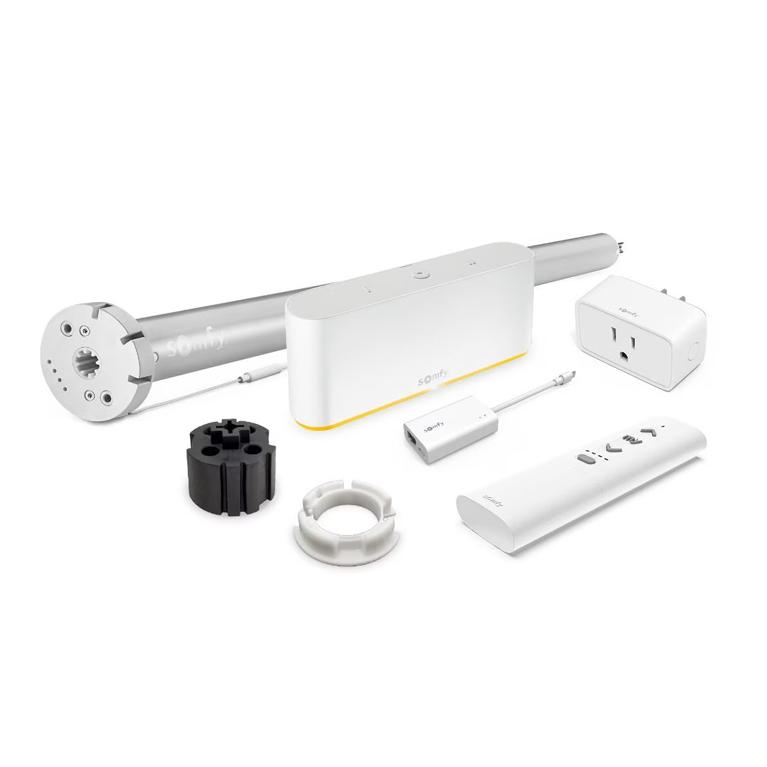
Short answer: A Somfy hardwired motor comes in two power classes. A 120V AC motor runs from line voltage, either as a 4-wire motor driven by its own wall switch or as a 3-wire RTS motor on constant power. A low voltage motor runs on 24V DC from a Somfy power supply over 14 to 18 AWG cable, and pairs with RTS remotes.

Hardwiring buys you a motor with no battery to charge and no torque ceiling from a battery pack. The catch is the wire itself. Each Somfy power class wants a different cable, a different switch and a different set of rules from the 500 Series Databook. Get the class right before an electrician pulls a single run.
The three ways Somfy wires a shade motor
Somfy builds the same Sonesse 50 chassis in several control versions, and the wiring changes with each one. The table sets the three hardwired options side by side, using Somfy's published wiring notes.
| Wiring type | Cable and conductors | Control | Several motors on one circuit? |
| 120V AC, 4-wire standard | 4-conductor SJTW: white neutral, red direction 1, black direction 2, green ground | Wired switch, one per motor, or a Somfy motor controller | No. Somfy prints "Do not parallel wire." |
| 120V AC, 3-wire RTS | 3-conductor SJTW: black hot, white neutral, green ground | RTS radio built into the motor | Yes, in accordance with the NEC and local codes |
| 24V DC low voltage | 2-conductor low voltage cable from a Somfy power supply | RTS radio built into the motor (Zigbee and dry contact versions also exist) | Yes, from a distribution enclosure with one output per motor |
Wire count alone will not tell you the control type. A 3-wire 120V motor carries a radio receiver, and a 4-wire motor carries none. Read the motor reference before you order switches.
120V 4-wire motors: one switch per motor
The Somfy Sonesse 506S2 Standard 120V 4-Wire Motor (1001814) is the plain wired version of the Sonesse 50. It delivers 6 Nm at 32 rpm, has no radio, and uses mechanical limits. Up and down come from two separate hot legs. Energize red and the shade travels one way, energize black and it travels the other.
Somfy prints one firm rule for its 4-conductor motors: do not parallel wire. Give each 4-wire motor its own switch. Somfy lists maintained and momentary toggle and paddle switches for its AC motor range, plus a double pole, double throw paddle switch.
Group control needs a controller between the switch and the motors. The Somfy IGC 4-in-1 Motor Control (1811416) powers and drives up to four Somfy Wired Technology motors on 120V, 60Hz, with three preset positions per motor, and runs from the DecoFlex Dry Contact Keypad (1811402). Daisy-chain several IGC units to run a whole room from one keypad.
Adding a remote later takes one part. The Somfy Universal RTS Receiver for 110V AC Motors (1810627) gives a standard Somfy motor RTS capability, so Situo remotes, Telis remotes and Eolis wind sensors can drive it. Somfy rates the receiver IP 66 on a 108 to 132V supply, which suits an awning or exterior screen motor as well as an indoor shade.
120V RTS motors: constant power, radio control
An RTS motor takes power and control on different paths. Line voltage feeds the motor at all times, and the 433.420 MHz radio inside handles up, down and stop. The Somfy Sonesse 506S2 RTS 120V Motor (1001809) runs the same 6 Nm, 32 rpm chassis as the 4-wire version, on a 3-conductor cable.
The wiring gets easier. Somfy allows parallel wiring of its 120V RTS motors in accordance with the NEC and local electrical codes, so one circuit can feed a row of shades. Somfy adds one radio rule: the power cord must run at least 12 inches and must not touch metal, since the cord serves as the antenna. Keep it clear of steel headers and metal fascia.
Somfy also offers its 120V motors with a UL-approved NEMA 5-15P plug-in cable. Plug the motor into a receptacle near the head rail, and Somfy notes that the plug-in option removes the need for an electrician. The receptacle itself still has to sit where the cord can reach it.
Low voltage 24V DC motors and the wire they need
Somfy's low voltage motors run on 24V DC. The Somfy Sonesse 30 RTS 24V DC Motor (1241142) fits a 1.13 in minimum inside diameter tube at 2 Nm for residential roller shades. For a larger shade in a quiet room, the Somfy Sonesse ULTRA 504A8 RTS 24V DC Motor (1134023) brings 4 Nm at a rated 35 dB.
Cable size sets the maximum run from the power supply to the motor. Somfy publishes these limits for its 24V DC motors:
| Cable gauge | Maximum power cable length |
| 14 AWG | 240 ft |
| 16 AWG | 150 ft |
| 18 AWG | 100 ft |
Plan the enclosure location with these numbers in hand. A motor 180 ft from the panel needs 14 AWG, while one 90 ft away can run 18 AWG.
Somfy states a second rule on its 24V DC motor pages: use only Somfy power supplies to keep the UL listing. One shade runs from the Somfy 24V DC Plug-in Wall Mount Transformer (1822209). A room or a whole floor runs from the Somfy 24V Power Distribution Enclosure for 10 Motors (1870192), which takes 120V, 60Hz in and gives each motor its own fused 24V DC output.

Picking 120V or low voltage for your project
The choice follows the building more than the shade. Use these rules of thumb, drawn from the wiring limits above:
- Exterior awnings, rolling shutters and heavy screens: 120V AC. Somfy rates the 24V DC motors above IP 20 and IP 30 for interior window coverings, and the high-torque LT50 and LT60 families run on line voltage.
- New construction with open walls: 24V DC home runs to a distribution enclosure. Low voltage cable is easy to pull before drywall, and one panel feeds up to ten motors.
- Retrofit next to an existing outlet: a 120V RTS motor with a plug-in cable, or a 24V motor with the plug-in transformer.
- A third-party automation system with relays: 4-wire 120V motors, one relay pair or one IGC channel per motor.
Torque still decides the motor size inside each class. Run the numbers with our guide on how to size a Somfy shade motor, then browse all Somfy motors by voltage and head type.
Electrician or DIY?
Line voltage wiring falls under the NEC and your local electrical code, and Somfy writes those codes into its wiring notes for both 120V and 24V DC motors. Somfy's enclosure kit guide calls for a licensed electrician to install the distribution enclosure. A homeowner can plug a 24V transformer or a NEMA plug-in motor into an existing outlet, pair a remote and set limits.
Splitting the job works well. The electrician installs boxes, receptacles, the enclosure and the cable runs. You or your shade installer then mount the motors and program them. Our Somfy power supply guide compares the plug-in and enclosure routes in more depth, and the Somfy control systems comparison covers SDN, the addressable RS485 option for commercial facades. Wiring diagrams for each motor reference live in our Somfy spec library.
Frequently asked questions
Can I wire two Somfy 4-wire motors to one switch?
No. Somfy's databook says "Do not parallel wire" for its 4-conductor 120V motors, which take separate hot legs for up and down. Give each motor its own switch, or drive up to four Somfy Wired Technology motors from the IGC 4-in-1 Motor Control (1811416) with a DecoFlex Dry Contact Keypad for group and preset control.
Do Somfy low voltage motors need an electrician?
A single 24V DC motor can run from the Somfy plug-in wall mount transformer (1822209) in a standard outlet, with no new wiring. A multi-shade job with a distribution enclosure and long cable runs is different. Somfy's enclosure kit guide calls for a licensed electrician, and Somfy ties its wiring notes to the NEC and local codes.
Is a Somfy hardwired motor better than a battery motor?
A hardwired motor suits jobs a battery cannot cover. Somfy's WireFree battery range tops out at 4 Nm and carries interior ratings, while wired Somfy motors run to 100 Nm and include IP 44 exterior families for awnings and shutters. Hardwired motors also skip the recharge cycle. Battery motors win on retrofits with no power at the window.
Can I add a remote to a Somfy 4-wire motor?
Yes. The Somfy Universal RTS Receiver (1810627) gives a standard 110V AC Somfy motor RTS capability, so Situo or Telis remotes, DecoFlex wall switches and Eolis wind sensors can control it. Somfy rates the receiver IP 66 on a 108 to 132V supply. A new motor with RTS built in is the other route.
Sources: Somfy 500 Series Databook (2022.05.16), wiring and cable rows for Sonesse 50 RA, Sonesse 50 RTS and Sonesse ULTRA 50 DC, and Control Accessories pages; Somfy Low Voltage Databook; Somfy Enclosure Kits RTS guide (7/2022); somfypro.com product records 1811416 and 1810627.
Shade Motors Direct is an authorized source for genuine Somfy motorized window shade, blind, and drapery parts.