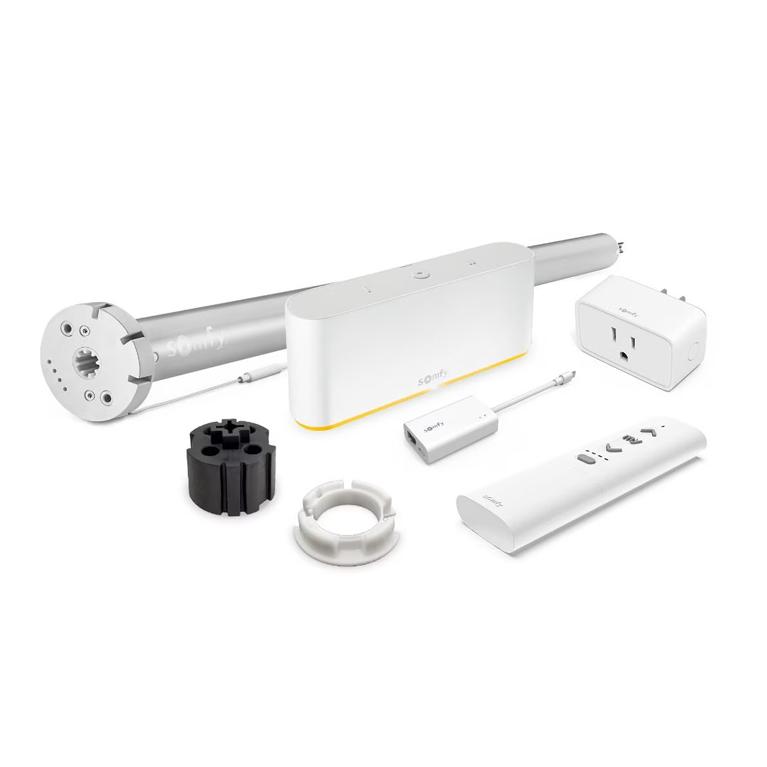
Short answer: Keep the wired 120V Somfy motor and add a Somfy Universal RTS Receiver 1810627 between the branch circuit and the motor. The receiver memorizes up to 12 RTS transmitters and up to 3 sensors, runs on 108 to 132 V, and sits in an IP 66 box at the motor.
A client asks for remotes on six wired shades. The expensive answer pulls six motors, re-tubes six shades and resets twelve limits. The cheap answer leaves every motor in place and adds one receiver per motor. This guide covers the cheap answer, done to Somfy's instructions.
Free spec package
Universal RTS Receiver retrofit drawing set

- SMD-01 general notes and system limits with sources
- SMD-02 receiver mounting and install detail
- SMD-03 riser, wiring detail and terminal schedule
- SMD-04 3-part guide spec, BOM and retrofit checklist
Keep the motor and add the radio
Somfy describes the receiver in one line: it provides RTS capability to Somfy's standard motors. Standard means wired. A wired motor such as the Sonesse 50 506S2 4-conductor motor 1001814 runs on power switching. Live on one direction conductor drives it one way, live on the other drives it back. The receiver does that switching for you and listens for RTS commands while it does.
The money sits in the tube. A swap to an RTS motor such as the Sonesse 510S2 RTS 1001807 means pulling the shade, moving the crown and drive, and setting limits again. The receiver leaves the motor, its limits and the fabric alone. You touch a junction box and a remote.
Our rule: retrofit with the receiver when the motor runs clean and the client wants radio control. Swap the motor when it is failing, undersized, or the job is moving to a wired bus such as SDN.
Check the motor and the circuit before you order
The receiver is a 120V/60Hz part. Somfy's e-cat lists a 108 V minimum and a 132 V maximum, Class II insulation and 433.420 MHz radio. It works with Somfy wired AC motors and with RTS motors, per Somfy's product page. It does not belong on a 24V DC motor.
Confirm the motor cable. Somfy's 500 Series databook gives the Sonesse 50 wired code as white = neutral, red = direction 1, black = direction 2, green = ground. The 600 Series databook uses the same four colors on LT wired motors. If you find a different color set in the field, stop and identify the motor before you wire anything.
Count receivers, not shades on a switch. Somfy prints "Do not parallel wire" for Sonesse 50 wired motors and "Do not wire two or more LT motors in parallel" for LT wired motors. Our rule: one receiver per motor. Two motors on one old switch means two receivers and a group channel on the remote.
Universal RTS Receiver 1810627: the numbers that matter
- Supply 120V/60Hz, 108 V min to 132 V max (Somfy e-cat)
- Up to 12 transmitters or channels and up to 3 sensors per receiver (instructions 25006270)
- IP 66, Class II, -4 to 140 °F working range (Somfy e-cat)
- RTS range up to 65 ft in optimal conditions (RTS Pocket Guide)
- Program button 2 s to pair, 7 s to clear all; MY 2 s saves, 10 s deletes
- Wind: UP after 2 s; sun: DOWN after 2 min, retract after 15 to 30 min
Mount the receiver where the radio can hear it
Somfy's instructions say to mount the receiver as close to the motor as possible. Outdoors, the connections face down so rain cannot seep in, and the label on the box says so. Keep the box off metal surfaces, which can cut radio reception. Use the watertight strain-relief fittings in the kit for every cable entry.
The box carries an IP 66 rating and a -4 to 140 °F working range on Somfy's e-cat, so a soffit or the wall beside an awning is fair game. Range is the RTS rule: up to 65 ft in optimal conditions, less through masonry. Our rule: walk the remote to the farthest point of use before you close the box.
Wire it and prove direction before anything else
The terminal block carries HOT, NEUT, GROUND and the motor terminals (MTR COM, UP, DOWN) shown in Somfy's wiring diagram. Bring the 120V branch in, run the motor conductors to the motor side, and bond green to ground. Power stays off until every conductor is landed.
Then test. The Sequence button on the receiver cycles UP, STOP, DOWN, STOP. Pair a transmitter and run DOWN. If the shade goes the wrong way, Somfy's fix is to turn off the breaker and reverse the red and black motor wires. On an awning this step is not optional: Somfy warns that a reversed motor will extend the awning in wind and damage it.
The limits never move. A wired motor keeps its own end limits, so the receiver stops where the motor stops. Set or adjust limits on the motor, per its own instructions, before the retrofit if they are off.
Program transmitters, sensors and two intermediate positions
Hold the receiver's program button for more than 2 seconds. The LED lights and the motor jogs. Press the program button on the new transmitter and the motor jogs again to confirm. Every later transmitter goes in from one already paired: hold its program button for more than 2 seconds, then press the program button on the new one.
Good first transmitters: a Situo 1 RTS Pure 1870571 for one shade, a Situo 5 RTS Pure 1870575 for a room, a Telis 16 RTS 1811081 for a whole floor, and a DecoFlex 5 channel WireFree wall switch 1810813 where the old wired switch lived. Each receiver holds 12 transmitters or channels in total.
The receiver stores two intermediate positions. Stop the shade where you want it and hold MY for 2 seconds. To delete one, send the shade there with a short MY press, then hold MY for 10 seconds until the LED stops blinking. To wipe every transmitter and sensor, hold the receiver's program button for more than 7 seconds until the LED blinks and the motor jogs twice.
Add wind and sun protection on an exterior job
This is where the receiver earns its keep on awnings and exterior screens. Somfy's page lists Eolis, Soliris and Sunis sensors, and the receiver takes up to 3. Common picks: the Eolis 3D WireFree RTS wind sensor 1816081 on the awning front bar, the Eolis RTS 24V wind kit 9012499 on the wall, or the Soliris RTS 24V sun and wind kit 9012500. Pair a Telis 1 Soliris RTS 1810635 so the client can switch sun automation on and off.
The timings come from Somfy's instructions. Wind above the set speed sends UP after 2 seconds and locks out other commands. Manual control returns about one minute after wind drops. Sun above the set level, with no wind, sends DOWN after 2 minutes, to the upper intermediate position if one is set. Sun below the level retracts the awning after 15 to 30 minutes. Somfy's wired, non-RTS sensors do not work with this receiver.
Bring the retrofit into a control system
Once the receiver is paired, the motor is an RTS channel like any other. A URTSI II 1810872 adds it to Control4, Crestron or Savant over RS232 or RS485 with 16 channels per unit. A TaHoma Switch 1871037 covers 40 RTS channels and app control. Both count against the receiver's 12-transmitter memory, so plan channels before you pair.
Our rule: pair the integration channel first, the client's remotes second, and the sensors last. You will know the system works before you hand over a remote.
Take the spec package to your submittal
Universal RTS Receiver retrofit drawing set
- SMD-01 general notes and system limits with sources
- SMD-02 receiver mounting and install detail
- SMD-03 riser, wiring detail and terminal schedule
- SMD-04 3-part guide spec, BOM and retrofit checklist
FAQ
Can one Universal RTS Receiver run two wired motors?
Plan one receiver per motor. Somfy's databooks say not to parallel wire Sonesse 50 wired motors or LT wired motors. Group the motors on a multichannel RTS remote instead.
Does the receiver change the motor limits?
No. A wired motor keeps its own end limits. The receiver switches the direction conductors, and the motor stops at the limits already set in it. The receiver adds two intermediate positions on top.
How many remotes and sensors can I pair?
Somfy's instructions give up to 12 transmitters or channels and up to 3 sensors per receiver. Integration channels from a URTSI II or TaHoma count toward the 12.
What if the shade runs the wrong way after pairing?
Turn off the breaker and reverse the red and black motor wires, per Somfy's instructions. Prove direction with a DOWN command before you pair any wind sensor.
Sources: Somfy product page and somfypro e-cat for Universal RTS Receiver 1810627; Somfy Universal Receiver RTS instructions ref. 25006270; Somfy RTS Pocket Programming Guide; Somfy 500 Series and 600 Series databooks; Somfy brochure for 1810627 (compatible transmitters and sensors).
Ryan Towns writes the Somfy Integrator Guides for ShadeMotorsDirect, an authorized Somfy distributor. Questions on a spec or a retrofit: 859-414-6872 or colin@shademotorsdirect.com, 8:00 AM - 7:30 PM ET.