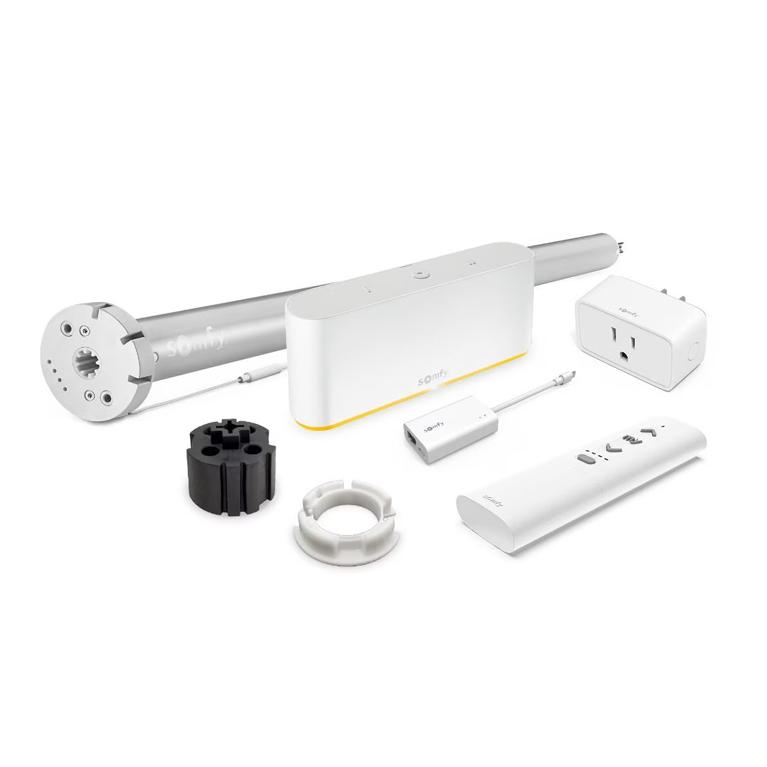
Short answer: The Somfy URTSI II (1810872) is a 16-channel Universal RTS Interface. It takes serial commands over RS232 or RS485, plus infrared, from a home automation system and transmits them as Somfy RTS radio signals. It ships with its own 9V DC power supply, reaches RTS motors up to 65 ft away, and cascades to 16 units for 256 channels.

The URTSI II's place in an RTS job
A control processor in an equipment rack speaks serial. A Somfy RTS motor listens for 433.420 MHz radio. The Somfy Universal RTS Interface II (URTSI II, 1810872) sits between the two. Your integrator programs the processor to send a short text string, and the URTSI II turns that string into the same RTS command a handheld remote would send.
That arrangement keeps the shade side of the job wireless. Each RTS motor needs line or low-voltage power and nothing else, while the URTSI II takes the one wired connection back to the rack. Somfy lists it for awnings, exterior solar screens, interior blinds, draperies and shades, pergolas and rolling shutters, and as compatible with all RTS motors and receivers.
Pick it when a home or project already runs a wired automation processor and the shades are RTS. If the client wants an app and voice control with no processor in the picture, a TaHoma hub fits better, and our TaHoma Switch vs URTSI II and UAI Plus guide lays out that choice.
URTSI II specs Somfy publishes
Every figure below comes from Somfy's product page for ref 1810872, the URTSI II spec sheet and the URTSI II operating instructions.
| Somfy name and reference | Universal RTS Interface II (URTSI II-16 Channel), 1810872 |
| Control inputs | RS232, RS485 and infrared |
| RTS channels | 16 per unit; cascade up to 16 units for 256 channels |
| Radio frequency | 433.420 MHz RTS |
| Maximum range | 65 ft radius under optimal conditions |
| Power | 9V DC plug-in transformer, 200 mA (included); power can also run over the CAT5 data cable |
| Power consumption | 20 mA |
| Serial settings | 9600 baud, 8 data bits, 1 stop bit, no parity |
| Status LED | Bi-color: green for power, red flash on each RTS transmission |
| Size | 4.02 x 2.99 x 1.38 in (102 x 76 x 35 mm) |
| Housing | ABS |
| In the box | URTSI II, antenna, power supply, DB9 to RJ45 adapter for RS232 |
| Warranty | 5 years |
What it controls: motors, receivers and channels
Each of the 16 channels holds one RTS address. Program one motor to a channel and the processor moves that shade alone. Program four motors to the same channel and the processor moves them as a group, the same way a single remote channel drives a bank of shades.
Any RTS motor qualifies. On a low-voltage roller job that might be the Somfy Sonesse 30 RTS 24V DC motor (1241142), a 2 Nm motor for tubes from 1.13 in inside diameter. Out on the patio, an awning running the Somfy 525A2 Altus RTS 120V motor (1043423) takes commands from the same box.
Older wired motors can join too. The Somfy Universal RTS Receiver for 110V AC motors (1810627) gives a motor with no built-in radio an RTS address, and the URTSI II programs to that receiver the same way it would to a motor head.
Each RTS motor stores up to 12 transmitters. The URTSI II channel uses one of those slots, so the client keeps a handheld remote or wall switch on the same shade for local control. The motor obeys whichever transmitter spoke last.
Wiring RS232 and RS485 to a control processor
The URTSI II takes its serial connection on an RJ45 jack. Somfy packs a DB9 to RJ45 adapter for RS232 in the box, and lists a separate DB9 to RJ45 adapter for RS485 (9015029) and an RS232 to RS485 converter (1810496) as options.
RS232 suits a single box. Set the rotary switch to position 1 and the unit answers to address 01. RS485 is the path for bigger jobs: Somfy allows 16 URTSI IIs on one RS485 network, each with its own address set on the rotary switch, and that is where the 256-channel ceiling comes from. Somfy also lets you power a URTSI II over the CAT5 cable and daisy-chain that power to the next unit, which removes a transformer from each extra box.
The command format reads unit address, channel, then direction, each address and channel written as two digits and the direction as a capital letter. Somfy's own examples:
-
0103Uplus a carriage return moves unit 1, channel 3 up. -
0210Dsends unit 2, channel 10 down. -
0105Dlowers channel 5 on unit 1. -
0112Sstops channel 12 on unit 1.
Over RS485 the URTSI II also accepts tilt increments of about one tenth of a second each, useful on products that tilt.
Programming URTSI II channels to RTS motors
Somfy publishes this sequence in the URTSI II operating instructions:
- Connect the included 9V DC transformer to the receptacle on the back of the box. The LED lights green.
- Keep the interface off and out of metal, since metal affects radio reception.
- Put the RTS motor or receiver into programming mode, following that motor's or receiver's own installation instructions.
- Turn the rotary switch to the channel you want. Letters A through F stand for channels 10 through 15, and 0 stands for channel 16.
- Press the programming button for one second at most. The shade jogs to confirm it memorized the channel.
- Repeat for each channel or product, up to 16.
- Test with the UP, STOP and DOWN buttons on the front of the box.
Step 3 depends on the motor generation and on the remote already paired to it. Our guide to pairing, adding and deleting a Somfy RTS remote covers the usual method with an existing transmitter, and the motor's install guide in our Somfy spec library gives the exact sequence for that model.
Infrared control and the 1-99 channel remote
The URTSI II also reads infrared. Plug Somfy's IR sensor (9015078) into the IR connector, aim the transmitter at the sensor, pick the unit number, then press up or down. The center button stops the shade. Somfy keeps the infrared channel active for three minutes after a command.
The matching handset is the Somfy 1-99 Channel IR Remote (1810498), the MultiChannel Infrared Transmitter Somfy names in the URTSI II instructions. It suits a media room where the AV remote and the shade remote share a line of sight to the rack.

Placement matters more than the input choice. The 65 ft radius assumes optimal conditions, and walls between the box and the motors shorten it. Mount the URTSI II clear of metal and near the shades it serves, then run the CAT5 back to the processor. For the rest of the RTS line, browse our Somfy RTS motors, remotes and receivers.
URTSI II questions
Does the URTSI II work with Somfy Zigbee motors?
No. The URTSI II transmits RTS at 433.420 MHz, and Somfy lists it as compatible with RTS motors and receivers. Zigbee motors run on a 2.450 GHz Zigbee 3.0 radio and need a Zigbee controller such as the TaHoma Switch. A house with both radios can run a URTSI II for the RTS shades and a TaHoma Switch for the Zigbee ones.
How many shades can one URTSI II control?
One URTSI II has 16 RTS channels. Each channel can hold one motor or a group of motors programmed to the same channel, so a single box can move far more than 16 shades. Somfy allows 16 URTSI IIs on one RS485 network, which gives a system 256 addressable channels.
Does the URTSI II report shade position back to the processor?
No. RTS is a one-way radio, so the URTSI II sends commands and receives nothing back from the motors. The processor shows the last command it sent. If the project needs live position feedback in the control system, Somfy's wired SDN motors with the UAI Plus interface or Zigbee motors with a TaHoma Switch provide it.
What power supply does the URTSI II need?
Somfy includes a 9V DC plug-in transformer rated at 200 mA in the box, and the unit draws 20 mA. As an option, Somfy lets you power the URTSI II over the CAT5 data cable and daisy-chain that power to the next unit, so a stack of interfaces in one rack does not need a transformer for each box.
Sources: Somfy product page and somfypro e-cat for ref 1810872 (Universal RTS Interface II, URTSI II-16 Channel); Somfy URTSI II Spec Sheet; Somfy Universal RTS Interface II Operating Instructions.
Shade Motors Direct is an authorized source for genuine Somfy motorized window shade, blind, and drapery parts.