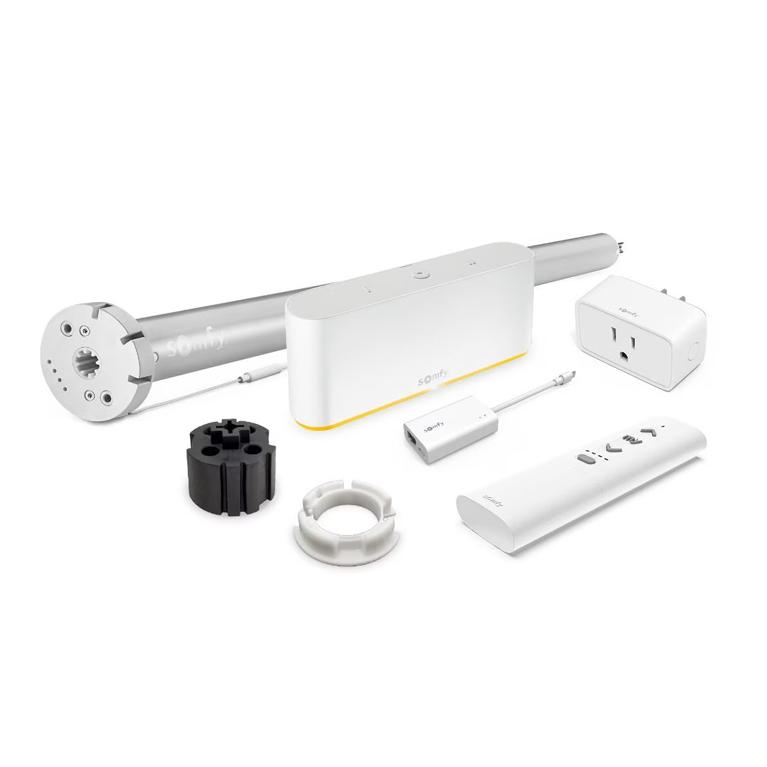
Installers reach for a DCT motor when the control side of the job is a wired switch, a keypad, or a relay output on someone else's processor. The Somfy Glydea ULTRA 35 DCT Drapery Motor (1246115) fits that brief. Somfy builds it as the dry contact member of the Glydea ULTRA 35 family, ships it on a 9.84 ft three-conductor VVF cable with a molded NEMA plug, and rates the head at 0.6 Nm with a 105 rpm belt speed. The motor arrives on its own. Track, carriers and drive pulley come separate.
Draperies this motor traverses
Somfy lists one application against reference 1246115: interior window coverings, draperies. The ULTRA 35 head suits RippleFold and pinch pleat panels on a Glydea track, in a residence, a hotel suite, or a conference room where a quiet open matters more than raw pulling power. The 35 in the name follows Somfy's kilogram convention across the Glydea line, which puts the trade figure for traversing capacity at 35 kg, or 77 lb of fabric.
Neither Somfy page for this reference prints that weight rating. The same gap shows on the ULTRA 35 RTS and the ULTRA 60 DCT, so the 77 lb number reads as a family convention rather than a published spec. Confirm heavy blackout or interlined panels against Somfy's Drapery Databook before you cut a track length. Panel weight picks the motor. Track length picks the belt, the carrier count and the number of ceiling brackets, and those four decisions travel together on the purchase order.
Dry contact wiring and the control side
DCT means dry contact. The motor takes an open or close command from a voltage-free contact closure, so a maintained wall switch, a relay output on a lighting panel, or a dry contact port on a control processor will drive it. Crestron, Control4 and similar systems all reach it through a relay module. The head carries no radio receiver, which rules out an RTS handheld: a Situo will not pair with this reference, and neither will a Telis. Buyers who want a remote in hand should order the ULTRA 35 RTS instead.
Somfy supplies the motor on a 9.84 ft VVF cable, three conductors, white, terminated in a NEMA plug. Power runs 100 to 240 V at 50/60 Hz, drawing 0.54 A and 30 W while the belt moves and 0.5 W at rest. The e-cat and the somfysystems.com product page disagree on the bottom of that supply window, with 100 V on one and 90 V on the other. The table below carries the e-cat figure.
Verified specifications from Somfy
| Somfy reference | 1246115 |
|---|---|
| Official designation | GLYDEA ULTRA 35E DCT US AFG |
| Torque | 0.6 Nm |
| Speed | 105 rpm |
| Sound level | 38 dB |
| Supply | 100 to 240 V, 50/60 Hz |
| Current | 0.54 A |
| Power in operation | 30 W |
| Standby power | 0.5 W |
| Protection index | IP 30 |
| Protection class | Class I |
| Limit switches | Electronic, repeatability +/- 10 |
| Thermal protection | 7 min |
| Cable | VVF, 3 conductor, white, 9.84 ft, NEMA plug |
| Dimensions | 12.28 x 3.66 x 2.09 in |
| Operating temperature | 32 to 140 F |
| Storage temperature | -22 to 176 F |
| Application | Interior window coverings, draperies |
| Approval | CTUVUS |
| Warranty | 5 years |
Figures come from Somfy's e-catalog entry for 1246115 and the matching product page on somfysystems.com. The 38 dB rating is the number that sells this head into bedrooms and boardrooms, and it holds across the Glydea ULTRA range.
Track hardware, carriers and the belt drive
A Glydea ULTRA 35 DCT will not move a panel on its own. The head clamps to a Glydea track and turns a toothed belt, and the belt runs to a drive pulley at the far end of the rail. Order the Somfy Glydea Drive Pulley (1780945) with the motor, because the belt tension the pulley sets governs panel noise and belt life.

Carriers ride the rail and hold the fabric. Somfy sells them by fullness, and the fullness you specify sets the count per foot of track: RippleFold 100% carriers (1780902) run six to the foot, while the 80% and 120% sets run five and seven. A center-open track needs a master carrier at each leading edge, and the Glydea Heavy Duty Master Carrier (1781344) earns its name on wide commercial panels where the leading edge takes the abuse.
Mounting goes to ceiling or wall. The Glydea One Touch Ceiling Bracket (1780907) snaps the rail into place without a screwdriver at each station, and on a 20 ft conference room track that saving adds up. Space brackets to Somfy's published interval and add one at every splice joint.
One caution on the store's compatibility list for this motor: it names the Glydea 60 Rotating Eye Runner (1781415), a part Somfy builds for the 60 rail rather than the 35. Skip it on a 35 build.
Plug-in modules that add Zigbee or SDN
Somfy builds two modules for the Glydea ULTRA head, and both change what a DCT motor can do after the track is already up. The Zigbee (2-Way) Module 9000043 brings the motor onto a Zigbee 3.0 network with feedback, which puts it inside a TaHoma scene alongside roller shades. The RS485 (SDN, 2-Way) Module 1871412 puts it on a Somfy Digital Network bus for addressable control and position reporting across a whole floor of draperies.
Specifiers use this to their advantage. A contractor can wire a building for dry contact today, prove the tracks, and add the network layer during commissioning without pulling a motor off the rail. That path keeps the hardware budget flat at rough-in and leaves the control decision open until the client has seen the panels move.
Setting limits and first power-up
The ULTRA 35 DCT uses electronic limits with a stated repeatability of +/- 10, which holds a panel's stop point across thousands of cycles. Setting those limits on a dry contact head calls for the Somfy Limit Setting Tool (9014599), the same tool Somfy names for Glydea ULTRA and Sonesse 30 DCT and RS485 motors. Somfy ships the DCT user instructions as document 5037610B, and the limit routine there is short once the tool is in hand.
Thermal protection cuts in at 7 minutes of continuous run, ample for a track of any length a drapery installer will build. Operating range runs 32 to 140 F, and the IP 30 rating with Class I grounding keeps this motor indoors. Plug the motor in before you hang fabric, run the carriage end to end, and set the limits on a bare belt. Fabric hides a fouled runner.
Put the Glydea ULTRA 35 DCT motor (1246115) on the order with the drive pulley, the carrier count your fullness calls for, a master carrier per leading edge, and enough ceiling brackets for the rail. Add the limit setting tool once per truck rather than once per job. Keep a Zigbee or SDN module in mind for the day the client asks for schedules.
Frequently asked questions
What does DCT mean on a Somfy Glydea motor?
DCT stands for dry contact. The motor responds to a voltage-free contact closure from a maintained wall switch, a relay output, or a control processor port. It holds no radio receiver, so Somfy RTS remotes and Situo handhelds will not operate it. Wire it to a switch or a relay, or add a Zigbee or RS485 module later.
How much drapery will a Glydea ULTRA 35 carry?
The 35 in the name follows Somfy's kilogram convention, which the trade reads as 35 kg or 77 lb of fabric. Somfy does not publish that rating on the 1246115 product pages. Confirm heavy interlined or blackout panels against Somfy's Drapery Databook, and step up to a Glydea ULTRA 60 when the weight calculation lands close to the limit.
Which limit setting tool works with this motor?
Somfy names the limit setting tool 9014599 for Glydea ULTRA motors along with Sonesse 30 DCT and RS485 heads. The tool plugs into the motor and walks the carriage to each stop point, where you store the limit. Set both limits on a bare belt before hanging fabric so a fouled runner shows itself.
Can this motor join a TaHoma system?
Yes, through Somfy's Zigbee (2-Way) Module 9000043. The module fits the Glydea ULTRA head and brings the motor onto a Zigbee 3.0 network with two-way feedback, which lets TaHoma run schedules, scenes and voice commands. The RS485 (SDN, 2-Way) Module 1871412 covers projects built on a Somfy Digital Network bus instead.
Shade Motors Direct is an authorized source for genuine Somfy motorized window shade, blind, and drapery parts.